It Is Well
When peace like a river, attendeth my way,
When sorrows like sea billows roll;
Whatever my lot, Thou hast taught me to know
It is well, it is well, with my soul.
Refrain
It is well, (it is well),
With my soul, (with my soul)
It is well, it is well, with my soul.
Though Satan should buffet, though trials should come,
Let this blest assurance control,
That Christ hath regarded my helpless estate,
And hath shed His own blood for my soul.
My sin, oh, the bliss of this glorious thought!
My sin, not in part but the whole,
Is nailed to His cross, and I bear it no more,
Praise the Lord, praise the Lord, O my soul!
For me, be it Christ, be it Christ hence to live:
If Jordan above me shall roll,
No pang shall be mine, for in death as in life,
Thou wilt whisper Thy peace to my soul.
But Lord, ’tis for Thee, for Thy coming we wait,
The sky, not the grave, is our goal;
Oh, trump of the angel! Oh, voice of the Lord!
Blessed hope, blessed rest of my soul.
And Lord, haste the day when the faith shall be sight,
The clouds be rolled back as a scroll;
The trump shall resound, and the Lord shall descend,
A song in the night, oh my soul!
(This hymn is in the public domain, so I have posted it in its entirety.)
This well-known hymn has become a favorite of mine in recent years. The story behind it is tragic and uplifting at the same time, speaking of the peace we have as believers in Jesus the Messiah. He is our salvation and comfort, even in losses that we can’t comprehend here on earth.
‘It Is Well’ was written in 1873 by Horatio Spafford after he was financially ruined by the Great Chicago Fire and all of his children died when their ship sank while crossing the Atlantic; only his wife survived. As he sailed to meet his wife, his ship passed the place where his daughters’ ship had gone down, and he was inspired to write the words above. (1)
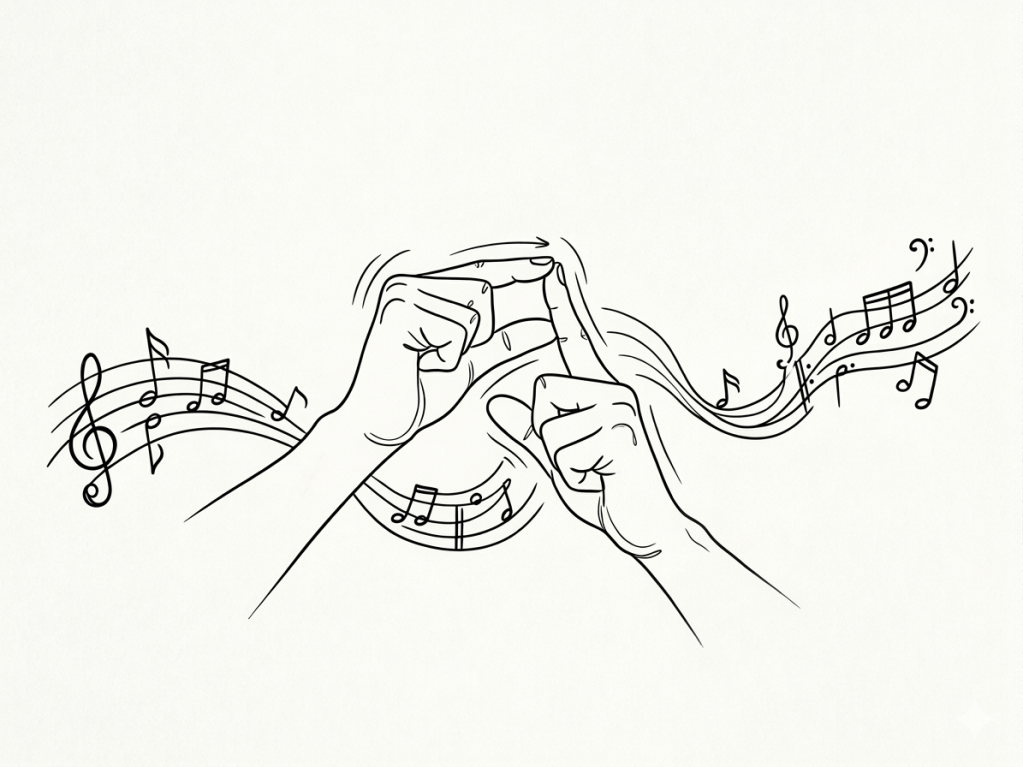
This hymn is 250 years old, so some of the concepts may be difficult for an interpreter. The slow pace of the song can also be challenging, but I think it gives interpreters an opportunity to really work with ASL. While there are actually six verses (Who knew!? Even my church, which sings every verse of every hymn, only has the four well-known verses in our hymnal.), note that there are slight differences in a couple of lines from what we’re used to singing today.
The gist of the hymn is that in whatever circumstances we find ourselves, we can trust in the promises God gives in the Scriptures. (2) He is sovereign and He is with us. (3) Using this as our foundation, we can make interpretive choices that make sense and convey the meaning of the hymn.
In verse one, a useful strategy might be to employ poetic devices from ASL, such as using the same handshapes throughout. PEACE/RIVER and SORROW/SEA, along with facial expression and other non-manual markers would express this verse beautifully and clearly. Perhaps the most difficult phrase, and of course the one used throughout the hymn, is the titular ‘It is well with my soul.’ I’m sure many of us have fallen into the trap of simply signing it exactly as it appears, using the sign GOOD. But does this really convey the intent of the hymn writer? It needs deeper thought. A couple of ideas: our souls are content with God, we trust/hold onto Him.
I’ll skip the chorus for now, because that can be resolved by repeating the phrasing of the same lines from the verses.
The second verse is relatively straightforward: a contrast between the first and second lines, and then emphasis on God sending Christ to shed His blood for our souls. It’s an assurance of our salvation, even through trials. (4)
The third verse makes me tear up every single time. Talk about assurance! This verse is so joyful, and perfectly set up to use contrast in ASL. Lean into it, and PRAISE THE LORD at the end.
I won’t spend much time on the next two verses as they aren’t typically included in our hymnals (tragic!), but I think having a look at them can help the interpreter carry the thought from the third to the final verse as the fourth and fifth build on the third and continue the idea of trusting in and depending on Christ for our peace and finally our salvation. We live for Christ, depending on Him through whatever trials we experience as we look forward to our ‘blessed rest’. This life is only a shadow of our eternal life with Christ. (5) One note if you do happen to interpret the fifth verse, the ‘trump of the angel’ would not be a modern trumpet, but rather the shofar, a ram’s horn, so use appropriate classifiers for that description.
The final verse gives us comfort that we will see our believing loved ones in heaven when we join them. It should also be a call to all believers to make sure that their loved ones know the gospel. For interpretation purposes, again, the trump should look like a shofar, not a modern trumpet. This verse has vivid imagery and lends itself well to the use of classifiers to describe the scene. The last line, sadly, has been changed to ‘Even so, it is well with my soul,’ so we lose the imagery of Christ’s coming in the night.
Last, but not least, is the chorus. Most churches sing it after each verse, even repeating it again at the end sometimes. Psalm 18.16-19 conveys the idea that the chorus expresses:
He sent from on high, he took me;
he drew me out of many waters.
He rescued me from my strong enemy
and from those who hated me,
for they were too mighty for me.
They confronted me in the day of my calamity,
but the Lord was my support.
He brought me out into a broad place;
he rescued me, because he delighted in me. (ESV)
There is debate about whether an interpreter should interpret the words of a song exactly as they are or convey the meaning, as they understand it. I don’t come down hard and fast on either side because I’ve heard arguments from Deaf people on both sides, so it really depends on the people for whom you interpret. If they want you to render ‘It is well with my soul’ in exactly those words, do it. If you have a little more flexibility, use some of the concepts from other parts of the song, perhaps even calling on imagery from the passage above.
Above all, ‘…whatever you do, do all to the glory of God’ (1 Cor 10.31).
References:
(1) https://en.wikipedia.org/wiki/It_Is_Well_with_My_Soul
(2) https://www.biola.edu/blogs/good-book-blog/2020/what-does-it-is-well-with-my-soul-mean
(3) https://www.crosswalk.com/church/worship/reasons-why-the-classic-hymn-it-is-well-with-my-soul-still-hits-home-today.html
(4) https://anglicancompass.com/behind-the-hymn-it-is-well/
(5) https://www.crosswalk.com/church/worship/reasons-why-the-classic-hymn-it-is-well-with-my-soul-still-hits-home-today.html


Leave a Reply