Yes, there’s homework. I’ll just give you a sampling of what’s required in each section of homework as I come to it.
The first homework assignments come at the end of the first section and involves identifying the handshape, location and movement of lists of signs and identifying similarities and differences of these elements between signs.
This goes to the study of linguistics of ASL and the importance of understanding that these elements have a massive impact on the clarity of your signing. Changing just one of these elements can change the meaning of what you’re signing. It’s also important to realize that completely unrelated signs may share one or more of the parameters while maintaining their individual meaning.
For example:
The sign UGLY shares the same handshape and movement as the sign SUMMER, but a different location. It shares the same movement and location as WORN-OUT, but a different handshape. And it shares the same location as KID, but different movement and handshape.
One I found challenging was DISCUSS. It contains two different handshapes (honestly, I’m not sure if I was supposed to focus on just the dominant handshape, but I found a sign that shared the same handshape for both hands). SHOW shares the same handshapes and location, but different movements. ARGUE has the same movement and location, but different handshapes.
The most difficult I found to be MONKEY. SALAD shares the same handshape and movement. And any sign that uses the classifier of bent 5-handshape would be the same handshape, but I wracked my brain for a sign that shares the same space as MONKEY, and I couldn’t think of one!
Anyone have a suggestion? And I’m sure someone will suggest something super obvious and I’m going to face-palm. I promise to take a picture and post it if that happens.
There was further homework building on these principles, but I won’t go into that here. I haven’t finished all of it either. One great thing about this textbook is that it includes a DVD with samples to look at and analyze for homework, but I haven’t had a chance to look at it.
I found this to be a good exercise in really analyzing and understanding different signs, their relationships to each other and how the different parameters of sign are used to change the meaning of different signs. I was a little surprised at how difficult I found some of the problems, but I’ve been out of school for some time, so I’ll blame it on that.
-
No comments on Homework…Eeek!
-
If you’ve never heard of boustrophedon, I’m about to show you what it is. Here it comes:
 In case you can’t read that, it says:Boustrophedon is the practice of writing forward on one line and backwards on the next. I should have practiced some more, as it’s been quite some time, but I find it so fascinating I had to share.According to https://www.britannica.com/art/boustrophedon, boustrophedon has been used for thousands of years, first by the Greeks. It made it easier to track from one line to the next without losing your place.In general, lefties (and as a lefty myself I can corroborate this) have a slightly easier time reading and writing right to left than righties do, so I find boustrophedon an enjoyable and entertaining pastime. Because I couldn’t find a way to type this way on the computer, I used my drawing app on my phone to make the above sample.Give boustrophedon a try, maybe post a picture of your attempt in the comments.Not only is boustrophedon a fun word, it’s a really cool historical practice.
 -
It’s been a few years since I’ve posted, but I’d like to get back to it. A few weeks (or months) ago, I started reading an amazing and massive book called *Evidence that Demands a Verdict, by Josh McDowell and Sean McDowell. I’m not sure how long I’ve been reading it because it’s so incredibly dense with information, so I’m reading it in small chunks—sometimes only one small section at a time—interspersed with my other reading. Rather than going back and discussing everything from what I’ve already read, I’m going to pick some of the topics I was most interested in to share here. Many of them will relate to common objections to Christianity and questions about the veracity of the Biblical accounts.
In the first chapter, the authors discuss how the Bible has survived through massive attempts to eradicate it through persecution and criticism.
Several Roman emperors attempted to stamp out Christianity by persecuting its adherents and burning Christian writings. Yet the Bible persisted and Christianity continued to expand. In the Soviet Union, in the 20th century, another attempt was made to eradicate Christianity by persecuting and killing Christians and confiscating and destroying Bibles. Yet it is still the most printed and distributed book in the world, especially in nations where reading or possessing it is banned. Why would that be? Obviously, It is important enough to its believers to risk their lives to have a copy.
The Bible is criticized in many ways by those who hate its message. I’ll discuss specific criticisms another time. Despite continued attacks, the Bible and its worldview still influences millions and spreads further year by year.
No other book is so attacked as the Bible, so it is important for those who believe the events recorded in this book, namely followers of Jesus, to be knowledgeable and prepared to explain, defend or answer objections and criticisms.
1 Peter 3.14-17: ‘But even if you should suffer for the sake of righteousness, you are blessed. And do not fear their intimidation, and do not be troubled, but sanctify Christ as Lord in your hearts, always being ready to make a defense to everyone who asks you to give an account for the hope that is in you, yet with gentleness and reverence; and keep a good conscience so that in the thing in which you are slandered, those who revile your good behavior in Christ will be put to shame. For it is better, if God should will it so, that you suffer for doing what is right rather than doing what is wrong.’ (NASB)
*All quotations and citations will come from McDowell’s book unless otherwise stated. I want to engage in good scholarship, but this is a blog, not an essay for college, so I will not be as strict with formatting citations, etc.McDowell, J., & McDowell, S. (2017). Evidence that Demands a Verdict: Life-Changing Truth for a Skeptical World. Thomas Nelson, Nashville.
-
An important part of becoming an interpreter, and being an experienced interpreter, is understanding the languages in which you work. Most of us already have a pretty good grasp of English and how to use it. (And if you don’t, I highly recommend doing some studying of English grammar and spelling). But we have to learn ASL, what it is and how it works.
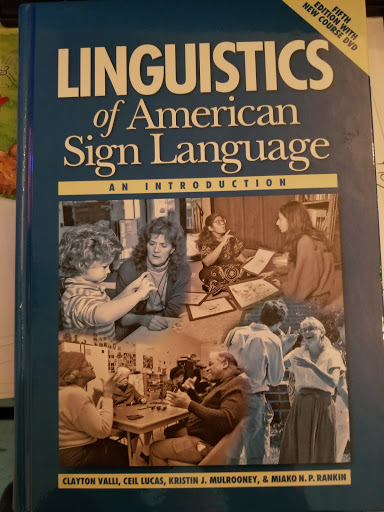
Just like English, and any other language, ASL has rules for structure and grammar. The parameters I discussed in my first post are important elements of the linguistics of ASL.*For my own edification, and because I’m a giant nerd, I’m reading this book: I thought it might help me stay on track and benefit others if I write about what I learn from the book. You will learn a lot about the linguistics of ASL in your sign language classes, but this book goes into far greater detail than your classes are able to. It’s possible that you will go on and study linguistics yourself, but I hope I can give you an overview and add to your knowledge, understanding and appreciation of American Sign Language.It’s easy to lose the parts of the language that are less like spoken language (classifiers, facial expressions) when many of us end up working in schools where students don’t really sign much or use a version of signed English, so it’s important to continue learning about the language we’ve been given the honor of having access to so that we can provide the very best interpretations possible. Even if you have to use signed English with a student or other client, there are ways to still incorporate important features of ASL that will improve clarity.The first couple of chapters in Linguistics of American Sign Language discuss the definitions of language and linguistics. I’m going to assume that you probably know what a language is and have a general idea of what linguistics is. It is important to note, however, that because ASL has only been relatively recently recognized as a legitimate language, it has also only recently begun to be studied by linguists. This is important in helping people understand that it is a legitimate language and not just gestures.The book lists a number of linguistic fields and I find historical linguistics the most fascinating. I love learning the etymology of words and how they develop and change through the years. I listen to a podcast called ‘The History of English’ and it’s so interesting learning how English became the language it is today and why it’s so crazy. I’d love to learn more about ASL in the same way – why we sign things certain ways, what a particular handshape or movement used to mean, etc.That’s all for now. I hope you find studying the linguistics of ASL as fascinating as I will!*Thank you to the friend who gave me the book for Christmas.
Valli, C., Lucas, C., Mulrooney, K. J., & Rankin, M. N. (2011). Linguistics of American Sign Language: an introduction. Washington, D.C.: Gallaudet University Press. -
I must bring to your attention another pet peeve of mine. There are a number of words in the English language that are compound words, but are apparently quite confusing for most people to write. They are not sure if they should be written as one word or separate words.
Nevertheless is one of these. Yes, you read that correctly. It’s one word. Along with it are synonyms (or at least close in meaning) nonetheless and notwithstanding. I suppose I can see how people could be confused by these words, especially if they were never specifically taught. Perhaps that means teachers need to take the time to introduce students to these wonderful words.
Most of us are likely resistant to running words together like this. As we’re taught from kindergarten – ‘Make sure you leave a finger space!’
Moreover, hereafter and heretofore are other examples of compound words that confound people. Wherewithal is another odd one; and I often see insofar and inasmuch written with separate words.
I find it interesting that these words likely ended up written like this due to being run together when spoken until people started writing them as one word. But now many are trying to separate them; while at the same time, other words like ‘a lot’ and ‘all right’ are being squished together.
I must confess, I’m resistant to using alot and alright. I don’t think they look right. I don’t think they should be used in good writing. I’ll probably be overruled on this at some point, but I’ll probably stick to my archaic spellings.
To stick with the theme of compound words, I offer this wondrous word: aforementioned.
Please remember to write the aforementioned words as one word. -
Just as spoken words have rules for pronunciation, so signed languages have rules for the correct formation of words. If you bend or break these rules you change the meaning of the words.
In American Sign Language, we call these particular rules the ‘Parameters of Sign.’ These are:
1. Movement
2. Location
3. Palm Orientation
4. Non-Manual Markers, and
5. Space
I was taught a handy mnemonic to remember these: ‘Mother Loves Plants with No More Spiders.’
I’m going to use the word NICE* as a base sign to demonstrate how changing any of these parameters (even just one) changes the meaning of what you’re signing.
The sign NICE has specific movement, location, palm orientation, non-manual markers and space that give it meaning.
The word NICE in ASL is made by sweeping one palm against the other one time from wrist to fingertips.
If we change the movement to a repeated motion, the word becomes CLEAN.
~I clean my room.
By changing the location of the word CLEAN, we can change the meaning again.
~I am cleaning.
~I clean my whole house.
Either of these can be indicated by moving around the sign CLEAN.
Going back to the base sign of NICE, if we change the palm orientation and movement to palm up brushing from fingertips to wrist, we now have the word NEW. Or clapping palm to palm gives you the word SCHOOL.
Signing the word CLEAN with raised eyebrows, as opposed to a neutral face, changes the sentence to a question.
~Did you clean your room?
Finally, space. Really, all of the above examples include changes in the use of space. In a visual-spatial language, it’s impossible to communicate without using space.
It’s important to pay attention to these parameters as you learn new vocabulary in ASL. It will become more important as you learn more complicated vocabulary and words that are similar to signs you already know.
*A word in all caps is a translation of an ASL sign called a gloss. It’s difficult to accurately convey ASL in written English. -
Greetings new signers! Whether you plan on becoming an interpreter or are taking ASL because you think it’s cool, I want to help you with some of the trickier aspects of the language.So I present: Tips from the Terp.I’ve been a Sign Language interpreter for 13 years, and every time I meet new students of ASL they seem to have the same questions, so I thought I’d try to answer some of these based on my own experience and with input from the Deaf Community and other interpreters.With that in mind, here is my inaugural post:If the thought of fingerspelling makes you cringe and reading fingerspelling makes you break into a cold sweat–Fear not! I have some tips that may help you learn how to become better at fingerspelling and reading fingerspelling.Reading Fingerspelling:One of the most important things to remember about fingerspelling is that you should be reading it just like you do words on a page. When we read, we see each word as a whole unit rather than individual letters. But it never fails that when I meet a new sign language student, they almost always try to read the individual letters when I fingerspell to them. It’s important to start training your brain early to see the shape and movement of an entire fingerspelled word rather than each individual letter.One way to do this is to silently sound out the word as it is spelled to you. Instead of thinking C A T, think CAT, just like you would if you saw the word on a page.Don’t panic if you miss a letter! Looking at the whole word will help you to still recognize the word if you take a moment; whereas if you’re saying individual letters, you’re likely to forget what the beginning of the word was by the time they reach the end.Context is also important. Stop and think if the word you thought you saw fits the context. You can always ask the person to repeat the fingerspelling if you still can’t figure it out.One other thing: don’t stare at the person’s hand. You want to be looking at their face (because they may be giving you hints by facial expression or mouthing), plus it’s just polite. Experienced signers know to fingerspell in a comfortable position that still allows you to see their hand while you look at their face.Producing Fingerspelling:My best advice for fingerspelling is almost the same as for reading fingerspelling. Don’t say the individual letters as you produce them, say the word that you’re spelling. When I introduce myself to you, I will never spell and say R O S E; I’ll spell it and say ‘Rose.’ It takes practice. You might be saying the word very slowly, but if you practice regularly, your speed will improve.One of my favorite ways to practice is fingerspelling restaurant and street names as I drive or when I’m a passenger. License plates are also good for practice because they have unusual combinations of letters and numbers. I’ll even stop and spell interesting words I come across when I’m reading.The only way to improve your speed and fluency is to practice regularly and don’t be afraid of it! Fingerspelling is fun!I hope you find these tips helpful. Look for more in the future. Feel free to ask questions or make suggestions! If I don’t know an answer, I will do my best to find one.See the video for an example of spelling a word while saying each letter, and then the same word with saying the word. It’s a silly example of a really long word, but it illustrates the point that it’s actually easier to say the word rather than the letters as you spell. I also misspelled in one spot on the first attempt. (Bonus points if you’re the first to post what the word is, spelled correctly!)
-
Greetings Readers!
It has been far too long since I last posted. I’ve finally been driven to write this by several comments I’ve seen on Facebook, all containing the same error.
When you want to be a part of something, you certainly don’t want to be apart; but this is a mistake I’ve seen people making frequently.
They type: ‘I want to be apart of that group,’ when they mean that they want to be included. They’ve essentially said exactly the opposite. ‘Apart’ is used to say that you are ‘pulling something apart,’ or ‘keeping things apart.’
It’s just a space, people! Doesn’t take up much space and important for clarity.
On a new subject, I’d like to start highlighting wondrous words, words that aren’t used much anymore or may have obscure meanings but are fun to say or read.
Today’s wondrous word: forewent
I forewent my turn at the game.
It’s the past tense of forego, which means to forfeit or not do something.
So, forego the misuse of apart and a part and make your grammar nerd friends happy! -
I enjoy reading. Not just enjoy – LOVE! It’s probably my favorite pastime. I regularly read multiple books at once, usually on my Kindle app. Unfortunately, there is an epidemic of poor grammar, spelling and punctuation in many of the self-published books available. If you want to publish a book – great! Get your work edited (preferably by someone who knows what they’re doing) before publishing, though!
In kindergarten, most students start the year writing their names, and most other words, with all capital letters or a mix of capital and lowercase. As the year progresses, they learn that their names should be capitalized, but only the first letter. They learn that ‘I’ is always capitalized; and they learn to not have random capitals in the middle of their words and sentences.
In self-published books, I see many poorly worded sentences and misused words, but one book I read took me back to kindergarten, where the author should have learned to correctly use capitals. She had problems with word usage too, but I just want to address the capitalization right now. It bothered me enough that I actually wrote a review on Amazon. And promptly got yelled at by another reviewer for only giving 3 stars because of grammar. That wasn’t the only reason I gave it 3 stars, but poor grammar detracts from my enjoyment of a book. It brings me to a screeching halt so I can try to figure out what the heck the author is trying to say.
The capitalization errors were actually minor compared to some of the other mistakes, but it was interesting because I’d never seen anyone make this particular error so dramatically. You’re probably saying, ‘Get to the point, already!’
Here it is: The words mom, dad, mother and father are ONLY capitalized when used as proper nouns, as in the place of a name or in direct address, and NOT when used as common nouns.
For example:
Yes – I told Mom that she should buy the dress.
No – I told my Mom that she should buy the dress.
Yes – I want Dad to come with me.
No – I want my Dad to come with me.
This author capitalized mother and father EVERY TIME she used them. and that was a lot of times. The book was about a family so ‘my Mother’ and ‘my Father’ were on nearly every page! Halfway through the book I was ready to scream, but I did like the story enough to finish the book and even read the next couple in the series. The author did fix some of her mistakes in the following books.
It’s a fairly straightforward rule. If you can replace mom, dad, mother or father with a name, capitalize it. I return to my previous example. If I replace mom with Kate (my mom’s name), does it make sense?
I told Kate that she should buy the dress.
I told my Kate that she should buy the dress.
The first one makes sense but the second doesn’t.
That is all.
pLease capItaliZe Your senTenCes CorrEctlY! -
I am definitely irritated by the frequent replacement of definitely with defiantly. As far as I can tell, this is simply a matter of people not paying attention when they’re typing. I would hope that people know the difference, though that may be asking too much. It’s one of those errors that is easy to make if you don’t pay attention to what you’re writing or typing.Another common error in both speaking and writing is the use of the incorrect past participle form of certain verbs, those used with have. There are many verbs that have unusual forms for the past participle. For example: have sung, have swung, have come, have begun, have done, have drunk, have eaten, have gone, have swum, and many more.*These are verbs that just have to be memorized because there is not necessarily a logical or consistent means of figuring out what the past and past participles should be. Many people, however, just use the regular past form with have, rather than the correct past participle. They say: I have sang a song; I have swang a bat; I have came to school; I have began a book; I have did this; I have drank pop; I have ate pizza; I have went to the store; I have swam in the pool.Actually with swang and swung, more commonly it’s actually the past pariciple used in place of the past tense: I swung the bat.These are further confused by those that don’t follow the pattern. It is drink, drank, drunk; but not think, thank, thunk. Sing, sang, sung; but not bring, brang, brung. That one IS frequently used by people trying to genralize the rule, but failing miserably.
English is a difficult language and it is distressing that more and more Americans don’t even know how to speak or write it correctly. Or they don’t care, which is almost as bad.*http://www.englishpage.com/irregularverbs/irregularverbs.html

 All the Writings