An important part of becoming an interpreter, and being an experienced interpreter, is understanding the languages in which you work. Most of us already have a pretty good grasp of English and how to use it. (And if you don’t, I highly recommend doing some studying of English grammar and spelling). But we have to learn ASL, what it is and how it works.
Just like English, and any other language, ASL has rules for structure and grammar. The parameters I discussed in my first post are important elements of the linguistics of ASL.
*For my own edification, and because I’m a giant nerd, I’m reading this book:

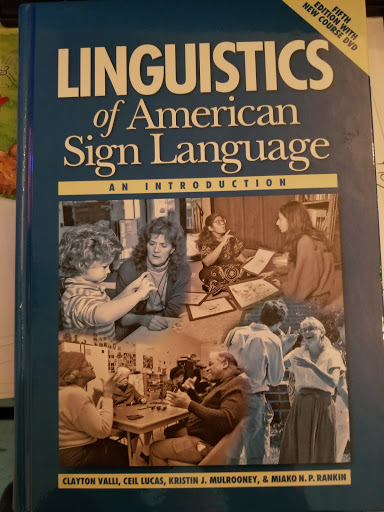
I thought it might help me stay on track and benefit others if I write about what I learn from the book. You will learn a lot about the linguistics of ASL in your sign language classes, but this book goes into far greater detail than your classes are able to. It’s possible that you will go on and study linguistics yourself, but I hope I can give you an overview and add to your knowledge, understanding and appreciation of American Sign Language.
It’s easy to lose the parts of the language that are less like spoken language (classifiers, facial expressions) when many of us end up working in schools where students don’t really sign much or use a version of signed English, so it’s important to continue learning about the language we’ve been given the honor of having access to so that we can provide the very best interpretations possible. Even if you have to use signed English with a student or other client, there are ways to still incorporate important features of ASL that will improve clarity.
The first couple of chapters in Linguistics of American Sign Language discuss the definitions of language and linguistics. I’m going to assume that you probably know what a language is and have a general idea of what linguistics is. It is important to note, however, that because ASL has only been relatively recently recognized as a legitimate language, it has also only recently begun to be studied by linguists. This is important in helping people understand that it is a legitimate language and not just gestures.
The book lists a number of linguistic fields and I find historical linguistics the most fascinating. I love learning the etymology of words and how they develop and change through the years. I listen to a podcast called ‘The History of English’ and it’s so interesting learning how English became the language it is today and why it’s so crazy. I’d love to learn more about ASL in the same way – why we sign things certain ways, what a particular handshape or movement used to mean, etc.
That’s all for now. I hope you find studying the linguistics of ASL as fascinating as I will!
*Thank you to the friend who gave me the book for Christmas.
 All the Writings
Leave a comment